
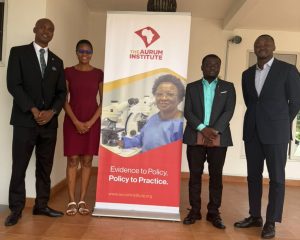
From the left; Dr. Paul Owusu Donkor, PhD (President, PSGH), Ms. Ethel Atanley (Country Director of Aurum Institute), Dr. (Pharm.) Harry Amoaning Okyere, ( Deputy Executive Secretary, PSGH) ,Nana Kofi Quakyi,(Country Director of Aurum Institute)
The Pharmaceutical Society of Ghana (PSGH) and the Aurum Institute have commenced discussions on a potential strategic partnership to strengthen public health interventions and scale up evidence-based programmes across Ghana. The high-level engagement brought together leadership from both organizations to explore areas of mutual interest and identify opportunities for collaboration that leverage their respective strengths in improving health outcomes and supporting national health priorities.
Leading the PSGH delegation was the President of the Society, Dr. Paul Owusu Donkor, PhD, who was accompanied by the Society’s Strategic Plan Manager and Deputy Executive Secretary, Dr. (Pharm.) Harry Amoaning Okyere. Representing the Aurum Institute were the Country Director, Nana Kofi Quakyi, and Ms. Ethel Atanley.
Discussions centred on how both organizations can work together to design and implement pragmatic, evidence-based programmes that address some of Ghana’s most pressing public health challenges. The meeting underscored the shared commitment of PSGH and Aurum to protecting and improving the health of the public through impactful and sustainable interventions.
Over the past few years, PSGH, through its Projects Department, has increasingly positioned itself as a key partner in public health programming. The Society has led and supported initiatives in maternal and child health, mental health, antimicrobial stewardship, and malaria elimination, while promoting the role of pharmacists as accessible healthcare providers capable of delivering meaningful health interventions at the community level.
The Aurum Institute, whose mission is to generate evidence for policy and translate policy into practice, has established itself as a leading public health organization with extensive experience in research, implementation science, and health systems strengthening. The organization has made significant contributions to the national and global response to HIV, tuberculosis, antimicrobial resistance (AMR), and several other public health priorities.
Recognizing the complementary strengths of both institutions, discussions focused on identifying areas where collaboration could create synergy, accelerate implementation, and support the scale-up of interventions that have already demonstrated impact. Participants explored opportunities to combine PSGH’s extensive professional network and implementation capacity with Aurum’s expertise in research, evidence generation, and programme implementation.
The engagement also highlighted the increasing importance of strategic partnerships in addressing complex health challenges. With healthcare systems facing evolving demands, both organizations acknowledged that sustainable progress requires collaboration among professional bodies, research institutions, policymakers, and implementing partners.
For PSGH, the discussions align with the Society’s broader vision of expanding the contribution of pharmacists to national development and public health. For Aurum, the engagement presents an opportunity to strengthen community-based implementation through one of Ghana’s most organized and widely distributed healthcare professional groups.
Both organizations expressed optimism about the prospects of the partnership and agreed on the need to continue engagements aimed at identifying priority areas for joint action.
As Ghana continues its pursuit of improved health outcomes and stronger health systems, the emerging collaboration between PSGH and the Aurum Institute reflects a shared belief that the greatest impact can be achieved when evidence, policy, and professional practice work together to serve the public good.
Should the partnership materialize, it has the potential to strengthen ongoing efforts in disease prevention, health promotion, antimicrobial stewardship, maternal and child health, and other critical public health priorities, ultimately improving the lives of communities across the country.





Leave A Comment