
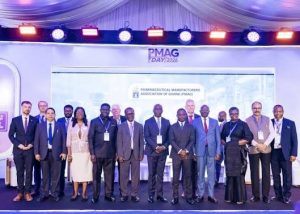
 Manufacturers, government, regulators, academia, professional bodies and financiers converged in Accra with a shared message: dependable access to medicines, industrial competitiveness and national resilience must be built together.
Accra, 28 July 2026
The Pharmaceutical Manufacturers Association of Ghana (PMAG) used its flagship PMAG Day 2026 to place local pharmaceutical manufacturing firmly within Ghana’s national security and economic transformation agenda, calling for coordinated action to turn the country into a competitive medicines manufacturing hub for West Africa. Held at the Alisa Hotel in Accra on Tuesday, 28 July 2026, the event marked PMAG’s 27th anniversary and brought together representatives of government, regulatory authorities, academia, research institutions, professional bodies, financial institutions, development partners and allied industries. The gathering was organised under the theme, “Advancing Ghana’s Pharmaceutical Sovereignty through Innovation, Requisite Skills Mix and Quality Industrial Value Chain for Economic Transformation.”
The theme reflected a concern that has become increasingly urgent since the COVID-19 pandemic and subsequent global supply disruptions: a country that relies heavily on imported finished medicines, active pharmaceutical ingredients, excipients, packaging materials and production equipment remains vulnerable when international supply chains tighten. Participants therefore framed pharmaceutical manufacturing not simply as a commercial subsector, but as strategic national infrastructure with consequences for health security, foreign-exchange stability, jobs, technology and resilience.
A national platform for a shared industrial ambition
The programme combined high-level addresses, three thematic panel discussions, an exhibition, special awards, business-to-business matchmaking and networking. Fraternal messages from partner organisations reinforced the event’s cross-sector character. The substantive discussions were organised around the three pillars embedded in the theme. The first considered how innovation could advance pharmaceutical sovereignty; the second examined the workforce and skills mix needed for industrial transformation; and the third focused on the quality industrial value chain, including finance, procurement, infrastructure and market access. Contributors were drawn from PMAG, PSGH, government ministries and agencies, regulators, industry associations, research and policy institutions, and the financial sector.
A later business-to-business session created space for manufacturers to engage institutions connected to finance, investment, trade, exports, taxation, environmental compliance and industrial development. Participating and invited institutions included commercial banks, the Development Bank Ghana, Ghana EXIM Bank, the Ghana Infrastructure Investment Fund, the Ghana Free Zones Authority, the Ghana Export Promotion Authority, the AfCFTA ecosystem, the Ghana Revenue Authority and the Environmental Protection Authority.
From medicine supply to strategic national infrastructure
Delivering the principal policy address, Presidential Adviser on the 24-Hour Economy and Accelerated Export Development, Augustus “Goosie” Tanoh, said Ghana must move from being predominantly an importer of medicines to becoming the pharmaceutical manufacturing and innovation hub of West Africa. He argued that the industry should be understood as central to health security, industrialisation, technology transfer, skilled employment, export competitiveness and national resilience.
“Pharmaceutical manufacturing is strategic national infrastructure. It is central to health security, industrialisation, technology transfer, skilled employment, export competitiveness and national resilience.”
Mr Tanoh said the recently approved Ghana Pharmaceutical Manufacturing Policy had provided a clear national direction: to position Ghana as the leading pharmaceutical manufacturing hub in West Africa, producing affordable, quality medicines while expanding into higher-value products and critical inputs. Ghana’s strengths, he noted, include a respected medicines regulator at World Health Organization Maturity Level 3, political stability, access to ECOWAS and AfCFTA markets, experienced manufacturers, capable universities and research institutions, and a growing pool of pharmacists, scientists and engineers.
The challenge, he stressed, is to convert those advantages into sustained industrial competitiveness. That requires Ghana to build an ecosystem rather than concentrate only on individual factories producing tablets and capsules. Priority components include active pharmaceutical ingredients and excipients; pharmaceutical-grade starches, ethanol and industrial chemicals; vials, blister foils, cartons and labels; quality-control laboratories; bioequivalence centres; cold-chain logistics; regulatory science; pharmaceutical engineering; digital manufacturing; and research and innovation.
PSGH’s stake in the manufacturing agenda
For PSGH and the wider pharmacy profession, the discussions carried implications far beyond factory output. A stronger local industry can improve the availability of essential medicines, reduce exposure to external supply shocks, create advanced career pathways for pharmacists and support a more integrated continuum linking research, regulation, manufacturing, procurement, distribution and patient care.
The skills discussion was particularly relevant to professional development. As manufacturing becomes more technology-intensive and internationally regulated, pharmacists will need deeper competencies in formulation science, validation, quality systems, regulatory affairs, pharmacovigilance, data analytics, automation, technology transfer and global market requirements. The meeting’s emphasis on curriculum reform and sustained academia–industry collaboration therefore offers an opportunity for PSGH, the Ghana College of Pharmacists, universities, the Pharmacy Council and industry to jointly define the future pharmaceutical workforce.
The next test: implementation
PMAG Day 2026 ended with an ambitious but pragmatic proposition: Ghana already possesses many of the ingredients needed to lead pharmaceutical manufacturing in West Africa, but those assets will not automatically become a competitive industry. The decisive test will be whether policy commitments are translated into coordinated institutions, financed programmes, predictable procurement, reliable infrastructure, measurable targets and sustained execution. The case advanced in Accra was ultimately about more than replacing imports. It was about using pharmaceutical manufacturing to secure medicine supply, retain scientific and economic value, create quality employment, conserve foreign exchange, deepen technological capability and position Ghanaian firms to serve regional markets. In that sense, pharmaceutical sovereignty was presented not as isolation from the world, but as the capacity to participate in it from a position of productive strength.



Leave A Comment