
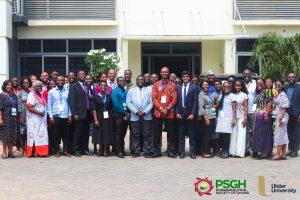
In a decisive move toward environmentally sustainable healthcare, the Pharmaceutical Society of Ghana, in collaboration with Ulster University, convened a high-level Community Pharmacists Stakeholder Workshop aimed at strengthening sustainable community pharmacy practices in Ghana. Held at the University of Ghana School of Public Health, the gathering brought together pharmacists, researchers, and sector leaders to chart a practical path toward greener pharmacy operations.
Rationale of the workshop

The workshop opened with a compelling address by the President of PSGH, Pharm. Paul Owusu Donkor, PhD, who set the tone by situating the initiative within both national priorities and global sustainability imperatives. He highlighted the urgency of addressing environmental challenges linked to healthcare delivery, noting that pharmacists, as highly accessible frontline professionals, have a critical role to play in driving responsible practices. He described the collaboration not as a theoretical exercise but as a deliberate effort to generate practical, scalable solutions capable of transforming everyday pharmacy practice across the country. In aligning the initiative with PSGH’s broader vision of integrating community pharmacy into primary healthcare, he emphasized that sustainability must become an intrinsic part of professional responsibility.
The concept of greener pharmacy
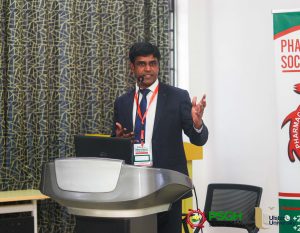
Building on this foundation, the technical session led by Kingston Rajiah and Charles Benneh of Ulster University introduced participants to the concept of “Greener Pharmacy.” Their presentations highlighted the environmental and public health consequences of pharmaceutical waste, from water contamination to the growing threat of antimicrobial resistance, as well as the economic burden of expired medicines. Framing the issue within the “One Health” approach, they emphasized the interconnectedness of human health, environmental sustainability, and responsible pharmaceutical practices. Greener pharmacy, they explained, is not an abstract ideal but a set of practical actions, including reducing medicine waste, improving stock management, ensuring safe disposal, and minimizing the environmental footprint of the medicines supply chain.
The COM-B framework
A particularly insightful dimension of the session was the application of the behavioural COM-B framework, which examines how Capability, Opportunity, and Motivation shape professional behaviour. Through this lens, it became evident that the challenge is not simply a lack of goodwill among pharmacists. Rather, gaps in knowledge, the absence of enabling systems such as medicine take-back programmes, and competing priorities in busy practice environments all combine to limit the adoption of sustainable practices. By framing sustainability as a behavioural issue, the discussion shifted toward realistic interventions that can drive meaningful change.
The presenters reinforced this perspective with a simple but powerful message: transformation can begin with small, manageable steps. They argued that even a single change implemented consistently within a pharmacy, such as improved stock rotation or patient education on medicine disposal, can yield measurable benefits. When scaled across hundreds of pharmacies, such incremental actions have the potential to significantly reduce waste, cut costs, and improve environmental outcomes nationwide.
Breakout sessions & roundtable discussions
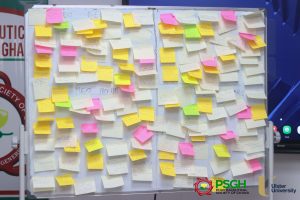
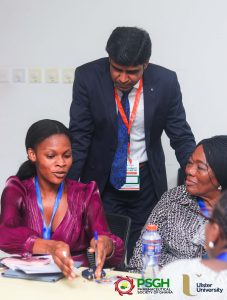 These ideas were further interrogated during a series of roundtable discussions, where participants shared candid insights from their daily practice. Across the discussions, a common picture emerged of persistent medicine wastage driven by overstocking, poor demand forecasting, and limited systems for tracking near-expiry products. Frequently, expired medicines, were cited as a recurring challenge. Yet, within these constraints, participants identified practical opportunities for improvement. Simple interventions such as adopting first-expiry-first-out inventory systems, conducting regular stock audits, and leveraging advanced inventory tracking tools were widely seen as feasible within a short timeframe. Many participants expressed confidence that such measures could lead to noticeable reductions in expired stock within months, alongside improved efficiency in medicine use.
The conversation also delved deeper into behavioural and systemic barriers. Participants acknowledged that while there is growing awareness of sustainability, many pharmacists lack clear systems to translate this awareness into action. At the same time, the absence of structured incentives means that sustainability often competes with more immediate operational priorities. However, there was strong agreement that professional pride, cost savings, and recognition could serve as powerful motivators. The idea of embedding sustainability into continuous professional development and introducing recognition schemes for green pharmacies gained considerable support as practical ways to drive change.

Beyond the pharmacy counter, the discussions highlighted the importance of stronger collaboration across the supply chain. Participants pointed to limited engagement with suppliers on issues such as flexible stocking and returns, as well as the absence of coordinated systems for managing pharmaceutical waste. There was a shared view that partnerships both among pharmacies and with suppliers, could significantly reduce waste. Equally, the role of patients was seen as critical, with calls for public education campaigns to encourage the return of unused medicines and promote safe disposal practices.
Environmental concerns remained central throughout the dialogue. Participants reflected on the tangible impact of pharmaceutical waste on Ghana’s ecosystems, particularly through water pollution and its contribution to antimicrobial resistance. Despite these challenges, there was optimism that low-cost interventions, such as segregated waste bins, improved patient counselling, and more rational dispensing, could make a meaningful difference. In this regard, community pharmacies were increasingly seen not just as points of care, but as important actors in Ghana’s broader environmental and climate agenda.
At the policy level, the discussions revealed significant gaps that must be addressed to sustain progress. The absence of clear national guidelines on pharmaceutical waste management and the lack of a structured medicine take-back system were identified as critical barriers. Participants called for the introduction of a national medicine return programme, supported by clear regulatory frameworks and incentives to encourage compliance. There was also a strong push for integrating sustainability into pharmacy education and professional training, ensuring that future pharmacists are equipped with the knowledge and skills required to lead in this space.
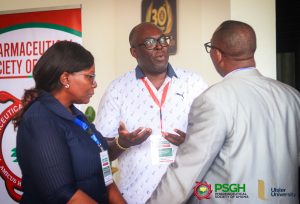
The workshop forms part of a broader research initiative focused on strengthening sustainable community pharmacy practices in Ghana through an understanding of behavioural determinants and the development of a capacity-building roadmap. By bringing together practitioners and researchers, the initiative is laying the groundwork for evidence-based interventions and long-term collaboration between Ghanaian institutions and Ulster University. It also aligns with wider global priorities around Net Zero targets, climate resilience, and sustainable healthcare systems.
As the workshop drew to a close, a clear consensus emerged: achieving sustainability in community pharmacy is both necessary and within reach. The discussions reinforced the idea that pharmacists are central to this transformation, and that meaningful change will come not from sweeping reforms alone, but from consistent, incremental improvements in everyday practice. With the leadership of PSGH and the continued partnership with Ulster University, the momentum generated at the workshop is expected to translate into concrete actions, setting Ghana’s community pharmacy sector on a path toward a more sustainable and environmentally responsible future.
Access the full gallery of the event here: FULL GALLERY: COMMUNITY PHARMACISTS STAKEHOLDER WORKSHOP







Leave A Comment